

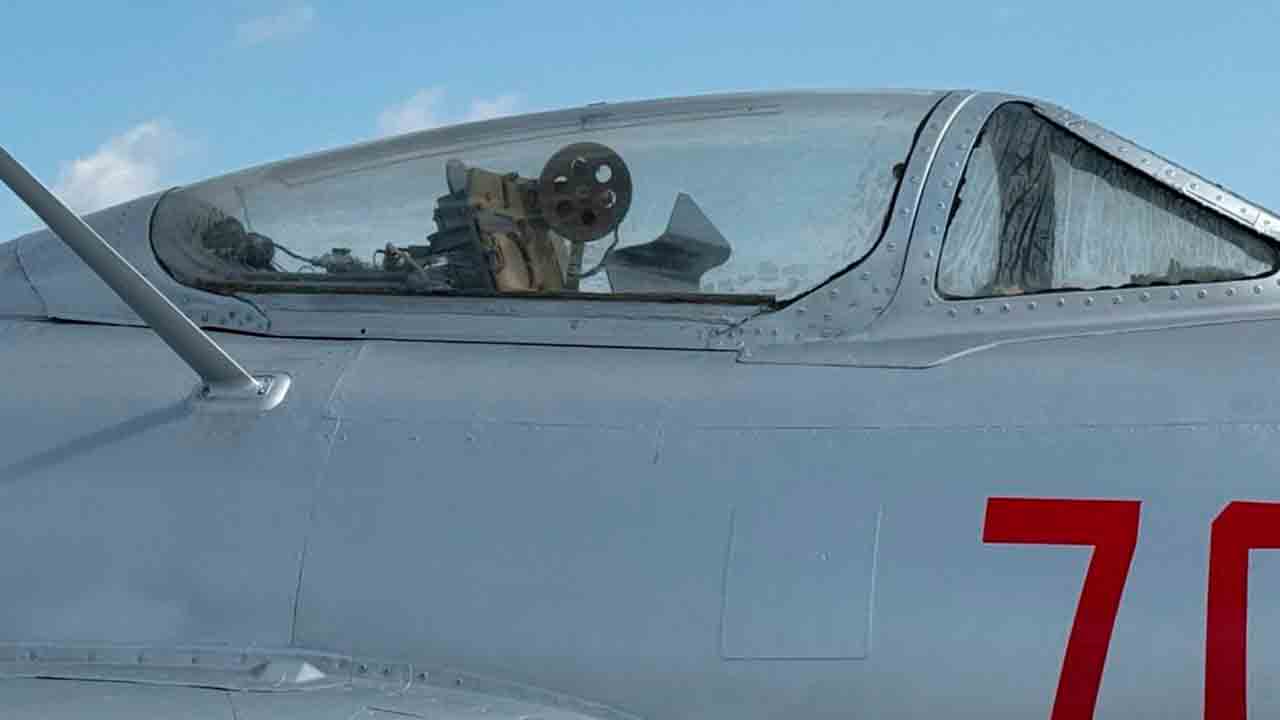
At the Changchun Air Show, recently held in China, an unmanned version of the J-6 fighter — an adaptation of a Cold War-era jet based on the Soviet MiG-19 — was publicly displayed for the first time.
The appearance of the modified aircraft drew attention and sparked new speculation about the use of legacy planes in mass drone operations.
According to Chinese sources cited by the event’s organizers, “this aircraft is modified from the J-6 fighter, with the removal of cannon weapon systems, external fuel tanks, and ejection seats.” The changes also include the installation of “an automatic flight control and autopilot system, additional wing pylons, and a terrain-following navigation system.”
According to details revealed at the exhibition — and with images published on Chinese social media such as Weibo — the unmanned version of the J-6 is said to have made its maiden pilotless flight back in 1995. Since then, the platform has been used in various roles, particularly as a training target and as a “threat platform” in simulated exercises.
Functions and Operational Purpose
The show’s organizers reported that the J-6 drone can operate both as an attack aircraft and as a training target, supporting simulated drills and live-fire exercises. Among its applications are training fighter pilots and supporting ground units responsible for anti-aircraft artillery, radar-guided missile systems, and tracking sensors.
China maintains a considerable stock of retired but airworthy J-6s. Converting these aircraft into unmanned platforms serves two obvious purposes: providing more realistic training for air defense crews and offering a cheap, expendable option as “decoys” to overwhelm adversary air defenses.
+ Impressive video: Israel unveils laser cannon that downs missiles for just $2
+ Mystery and Horror: Marian Izaguirre’s Last Video Before Her Death Shocks Fans
Technological Context and International Comparisons
Although Beijing has already developed advanced UAVs — including stealth-capable platforms such as the GJ-11 and WZ-8 — the repurposing of older fighters reflects a layered approach to future air warfare: deploying both sophisticated drones and converted legacy jets for different missions.
The conversion of legacy aircraft into drones is not new worldwide. The United States Armed Forces, for example, have for decades operated QF-16 and QF-4 aircraft converted into target drones for realistic weapons testing and training. The difference in China’s case may lie in the scale and potential application: the mass transformation of J-6s into unmanned platforms could go beyond training and integrate saturation tactics in a real conflict.
Implications and Speculation
The presence of the unmanned J-6 at the Changchun Air Show fuels speculation among analysts and observers about the possibility that China is refining tactics to deploy swarms of drones or waves of low-cost platforms to exhaust and confuse enemy air defense systems. Combined with advanced UAVs, such a strategy could significantly complicate air defense in high-intensity scenarios.
Although the exhibition confirms that the project exists publicly and that operational conversion capabilities are in place, it is still unclear what the scale of the program will be or whether the converted versions will be routinely employed in exercises beyond those already announced. The images and information released on Weibo and through the event’s communications remain the main source for understanding the details of this adaptation.
Source and images: Defence-blog | Weibo. This content was created with the help of AI and reviewed by the editorial team.
